Further on my earlier sharing on
SOYA vs GOUT, I would like to share an article about this misconception here.
WHAT IS GOUT?
Gout is the most common form of inflammatory arthropathy in adults. People with gout tend to suffer from hot, painful, and inflamed joints.
Over time, joints affected by gout can become swollen and large with the development of hard nodules, called tophi, in the joints and in the surrounding soft tissue. This causes permanent damage to the joints.
Gout is primarily caused by high levels of uric acid in the blood. Uric acid is produced when our bodies break down purines—substances found naturally in our bodies and in many of the foods that we eat.
WHAT SHOULD GOUT SUFFERERS AVOID EATING?
Gout sufferers should avoid certain foods high in purine. Here are some foods to avoid:
Meats and Animal Products
Meat tends to be high in purine, and the worst offenders are the organ meats, such as liver, tripe, and tongue! Other meats, such as chicken, pork, and duck, should also be limited to about 4 ounces (about 113 grams) a day.
Products derived from meat, such as meat stocks and gravies, and chicken essence, should also be avoided.
Seafood
Fish and seafood are common sources of purine. Scallops, sardines, herrings, anchovies, and mackerel are worse than lobsters or abalone. For example, 100 grams of lobster contain 118 mg of purine while 100 grams of sardine contain 480 mg of purine.
Other seafood to avoid include:
Tuna
Codfish
Halibut
Salmon
Trout
Alcohol
If you have gout, of all the alcoholic drinks, you want to avoid beer the most. Generally, beer is worse than other alcoholic drinks like red wine or spirits. However, it ultimately depends on the strength and amount of alcohol consumed. It is still best to avoid alcohol entirely.
DO PLANTS CONTAIN PURINE?
Yes, plants can also contain purine. There are some plant foods that are high in purine, such as:
Asparagus
Cauliflower
Soybean
Mushrooms
Mung beans
Sunflower seeds
DO PLANT PURINES CAUSE GOUT?
Plant purines do not cause gout.
Research published in the Annals of the Rheumatic Diseases, an internationally peer-reviewed journal, showed that intake of purine from animal sources, for example, meat and seafood, increased the risk of gout. However, purine from plant sources does not increase the risk of gout. In fact, they found that eating more vegetable protein could actually lower the risk of gout. Researchers attributed this effect to the existence of phytonutrients in plant foods as compared to animal products.
Other studies have supported this finding. For example, a study published in the journal Nutrition, Metabolism & Cardiovascular Disease showed that soy can actually lower the risk of hyperuricemia (excessive uric acid in the blood), which, in turn, could lower the risk of gout.
Researchers from the National University of Singapore looked at over 50,000 Chinese people, as their diet was traditionally high in soy products, such as tofu. This study, the largest of its kind in Asia, confirmed what several other studies done in Japan and Taiwan had found: soy did not increase uric acid retained in the blood. In fact, they found that those who ate more soy had a lower risk of gout than those who ate the least.
WHAT FOODS CAN BE GOOD FOR GOUT?
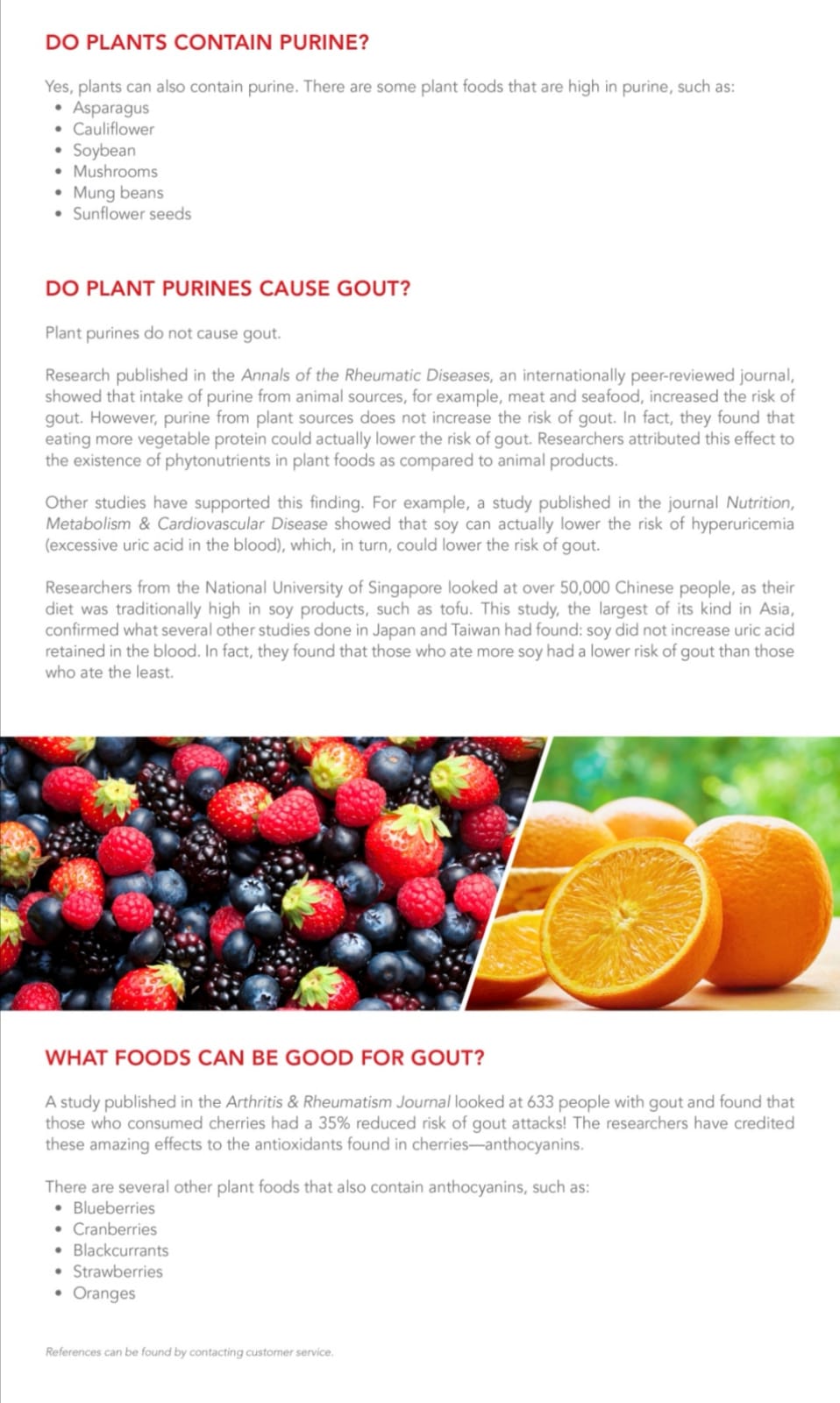
A study published in the Arthritis & Rheumatism Journal looked at 633 people with gout and found that those who consumed cherries had a 35% reduced risk of gout attacks! The researchers have credited these amazing effects to the antioxidants found in cherries—anthocyanins.
There are several other plant foods that also contain anthocyanins, such as:
Blueberries
Cranberries
Blackcurrants
Strawberries
Oranges
Happy reading :)
Jinny
92963562